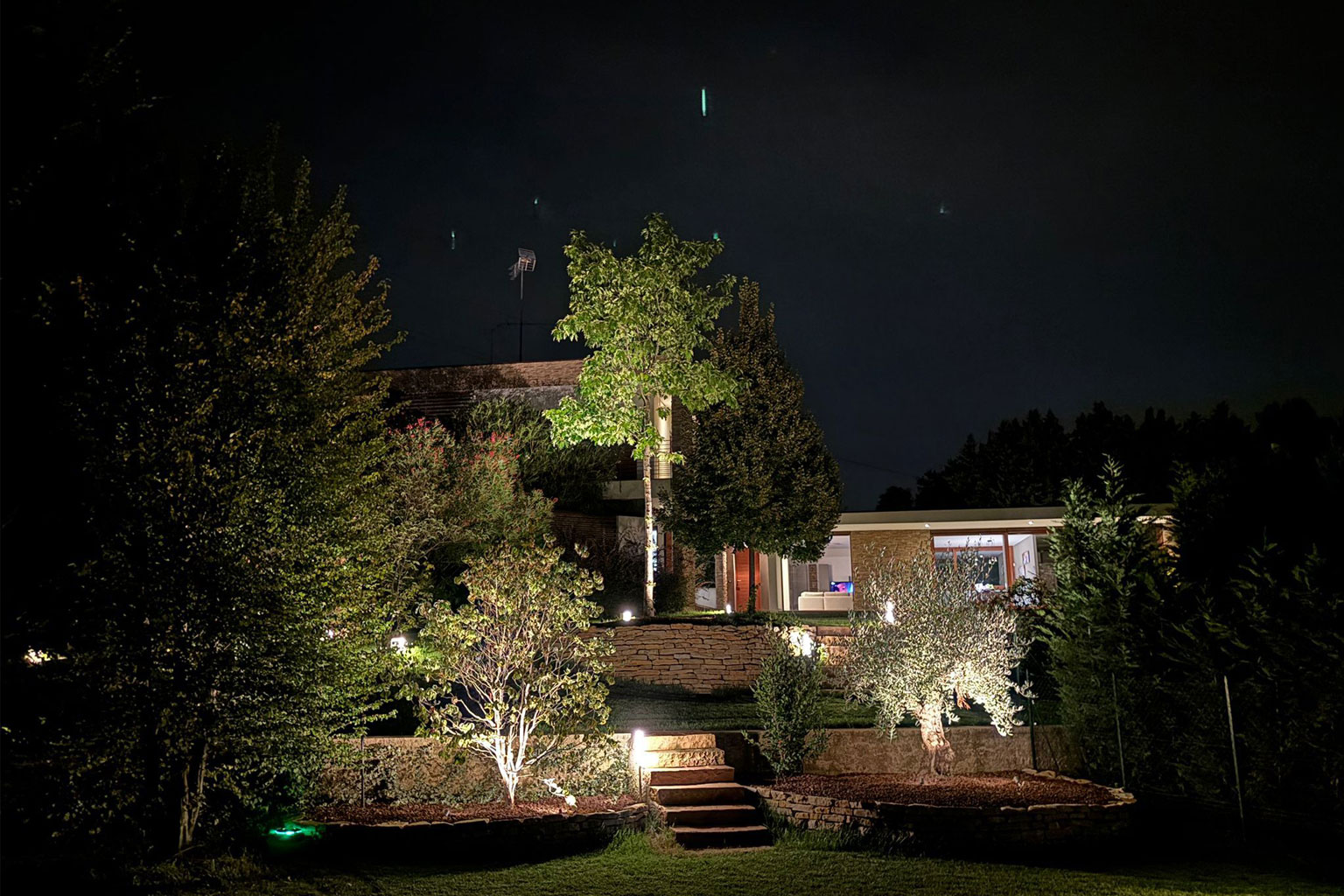
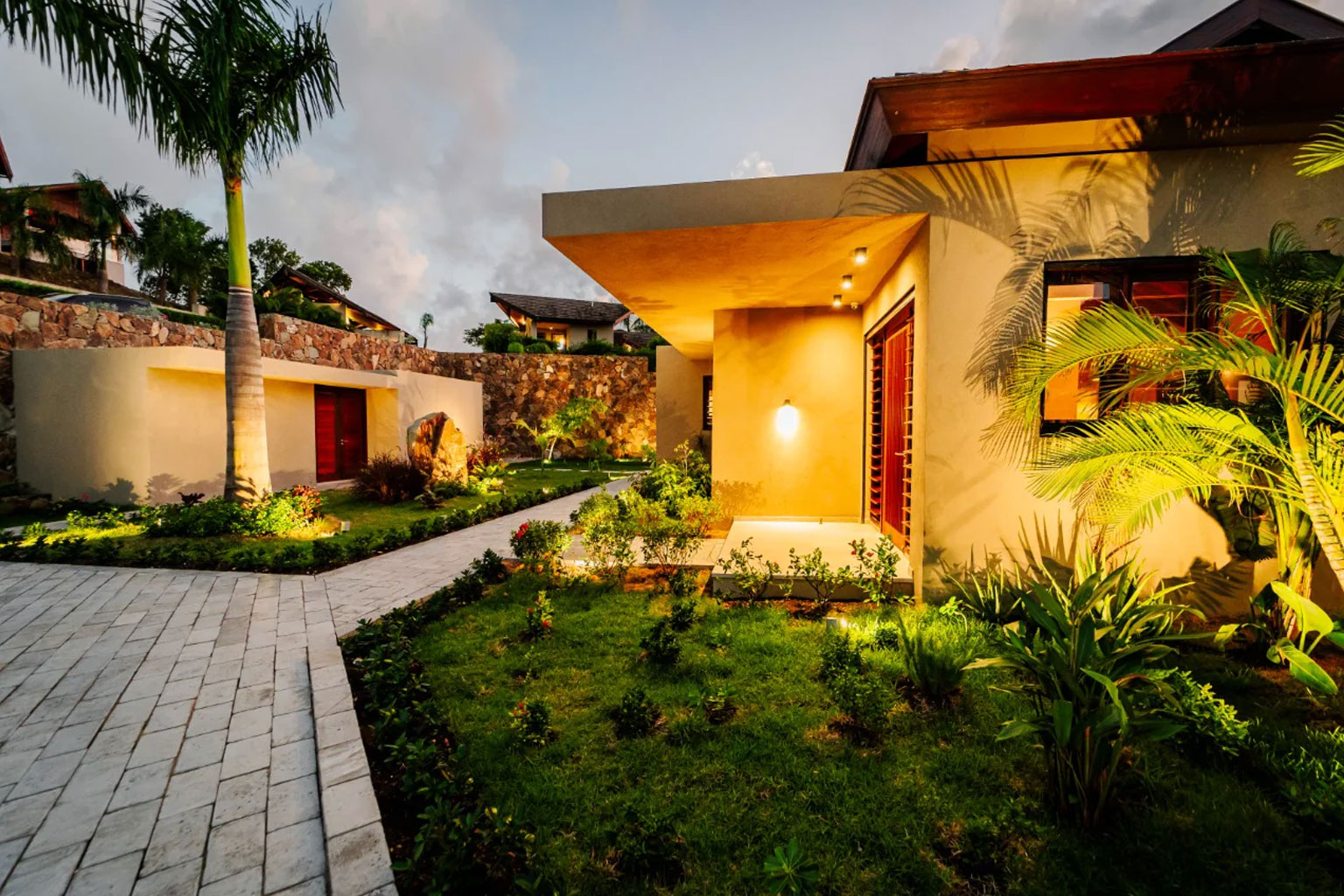
A luminaire installed indoors is a controlled object: stable temperature, no humidity, no UV exposure. The moment a lighting fixture is placed outside, it enters an entirely different world, where rain, salt air, thermal cycling, ultraviolet radiation, and mechanical wear are constant variables.
In this context, the quality of a luminaire does not depend only on its technical characteristics, but also on the coherence between materials, finishes and lighting performance. The materials it is made from, and the way those surfaces are treated, determine how long it will last, how reliably it will perform, and whether the design intent will survive contact with the real world. Surface treatment is not a finishing detail. It is the point where design meets reality.
Reinforced Anodizing
When metal meets the outdoors, the question is not whether it will be affected, but how well it is prepared to resist. For aluminium, the answer lies in anodizing: an electrochemical treatment that converts the metal surface into a dense layer of aluminium oxide. Unlike conventional painting, this layer does not sit on top of the material. It becomes part of it, integrating into the metal’s own structure.
Twenty microns is the specification that matters for professional-grade exterior use. At this thickness, the anodized layer delivers high corrosion resistance, withstands abrasion and scratching, and remains stable under UV exposure for years without fading or flaking. It can be coated in a wide range of tones, from natural anthracite to deep black to warm bronze, and whatever tone is chosen retains its quality over time. For lighting designers, 20 microns is not a premium option. It is the baseline.
Marine Grade
Salt-laden air changes everything. In coastal environments, the combination of humidity, chlorides, and UV intensity creates conditions that will rapidly degrade any surface not specifically engineered to resist them. Standard anodizing alone is not enough. Marine grade treatment is.
This is a multi-layer system: abrasive blasting to prepare the substrate, an anti-corrosion epoxy primer as the base coat, and a polyurethane or polyurea topcoat that seals the whole against salt mist, UV radiation, and chemical agents.
Within ten kilometres of the coast, every luminaire is effectively exposed to salt. For this reason, marine grade coating is not applied as standard, but on request, for any product where it is required, as in the case of Cavea. Marine grade coating gives the product intrinsic resistance to chloride-induced corrosion. This is the combination that holds when the sea is right outside the door.
PVD: The Advanced Surface
Physical Vapor Deposition operates on an entirely different principle. Inside vacuum chambers, metals such as zirconium, chromium, and titanium are vaporised and drawn onto the substrate by an electrical potential difference, condensing on the surface to form a coating that bonds at the atomic level. No chemical agents, no electrochemical reaction. A purely physical process, among the cleanest available in industrial surface technology.
The result is exceptional: abrasion, scratch, and corrosion resistance superior to conventional treatments, full UV stability, and applicability across metals, glass, and ceramics. From a design perspective, PVD opens up a palette that is difficult to achieve with durability in outdoor conditions: deep blacks, warm bronzes, metallic tones that hold their precision after years of exposure. The finish specified is the finish delivered over time.
Outdoor materials
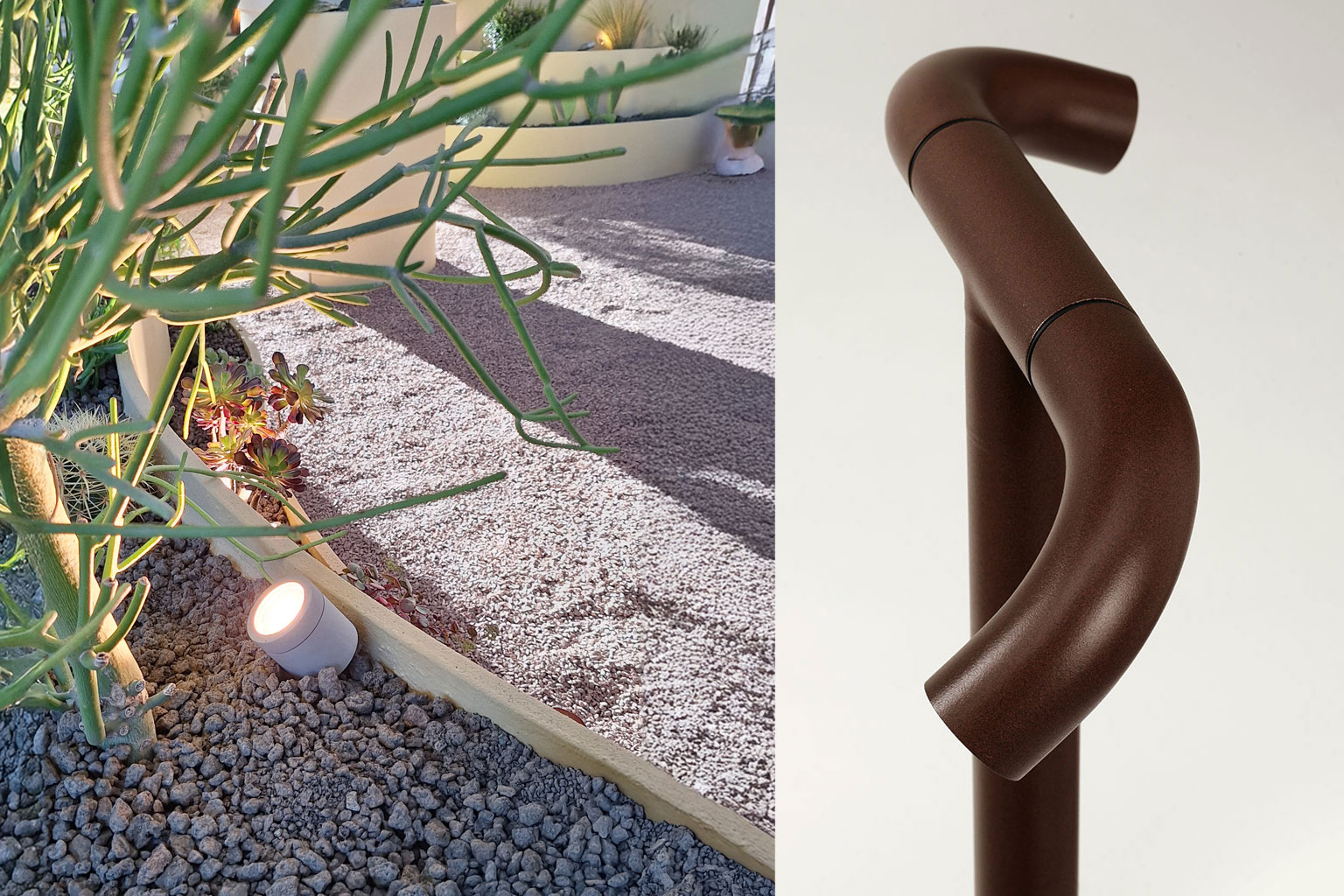
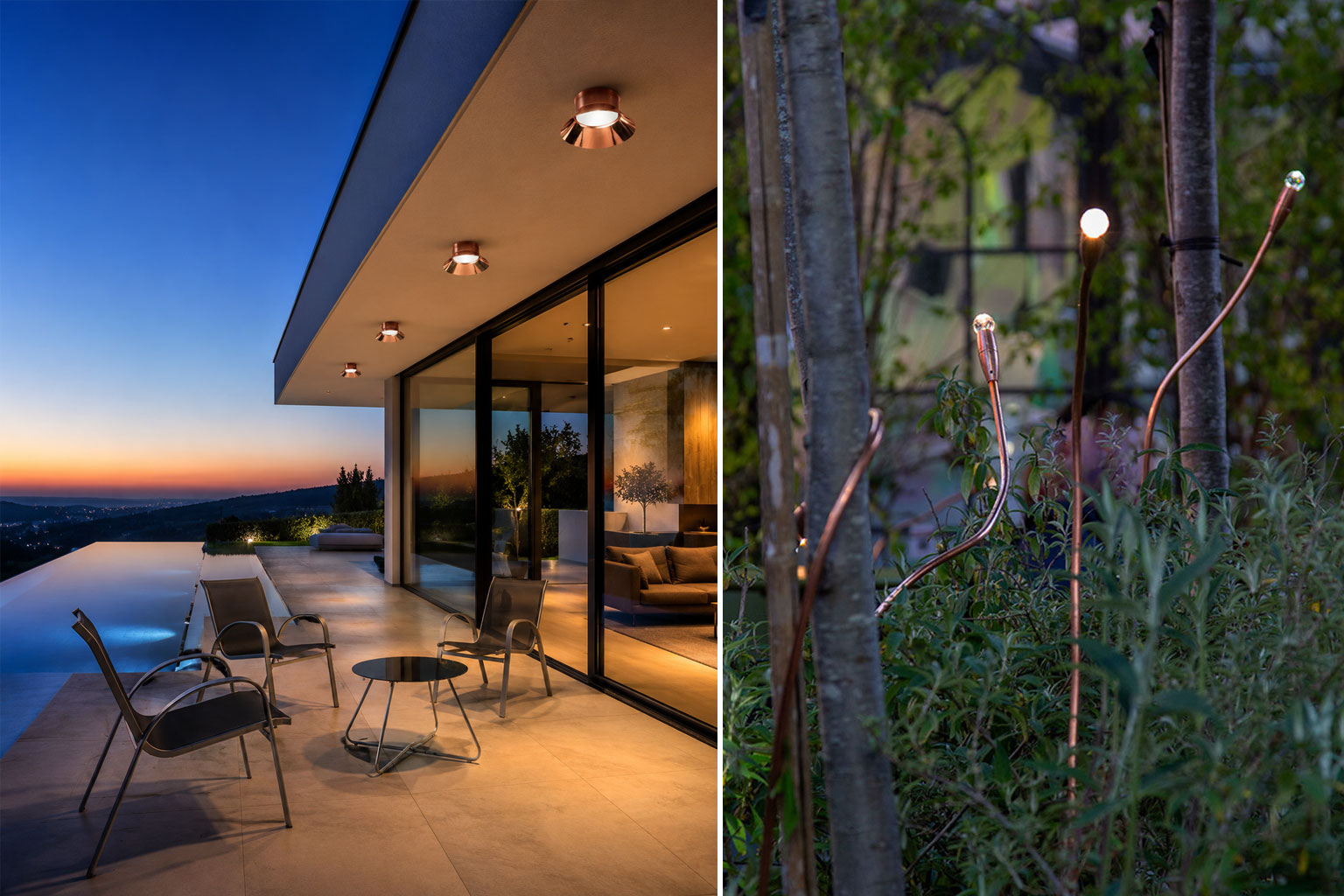
Not all materials are chosen because they resist the environment. Some are chosen precisely because they respond to it. The natural copper stem of Trilli develops a characteristic patina over time, moving from warm orange-red tones through bronzed browns toward the green of advanced patination. This is not degradation. It is the material recording its own history in the place it inhabits. Choosing natural copper outdoors means embracing a surface that will change, deepen, and acquire character over the years.
Jazz tells the other side of the same material. In its polished copper version, protected by a special coating, its golden finish remains unchanged over time. Two interpretations of copper: one that embraces transformation, the other that suspends it.
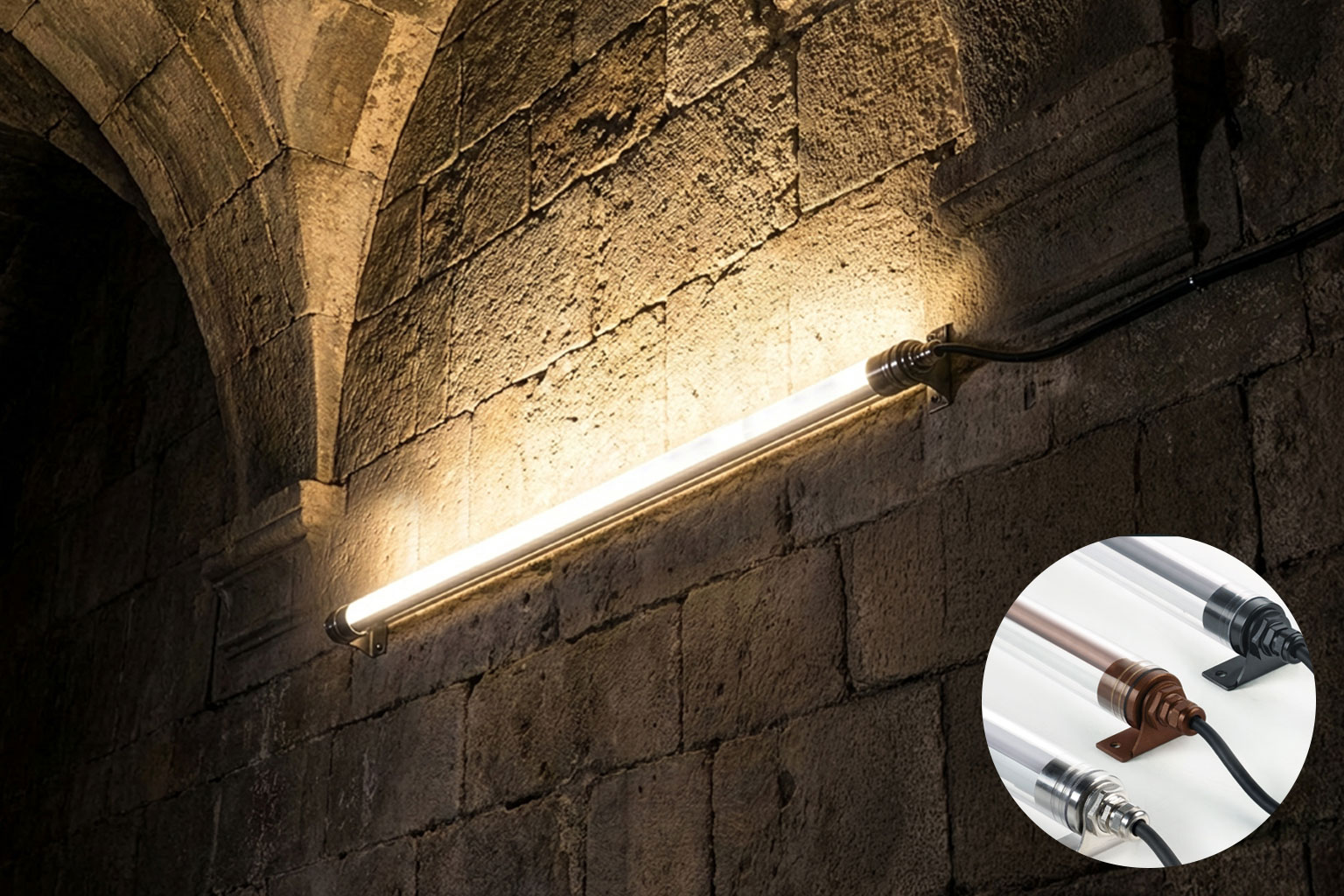
Wanda takes yet another approach to the same question. It is an orientable IP67 diffused-light bar luminaire, designed for wall and ceiling applications, with a body in anti-UV co-extruded transparent methacrylate, AISI 316L stainless steel end caps, and a neoprene cable. It is available in three finishes, each with a different relationship to time.
AISI 316L stainless steel resists chlorides without changing. The painted Corten finish evokes rust tones, stable by design choice and not through actual corrosion. The anthracite, painted over a reinforced anodizing base for exterior use, holds its tone unchanged through UV, humidity, and thermal cycling. Available in modular lengths from 18 to 298 cm and in an RGB version, Wanda adapts its scale and colour to the project.
Surface as a Design Decision
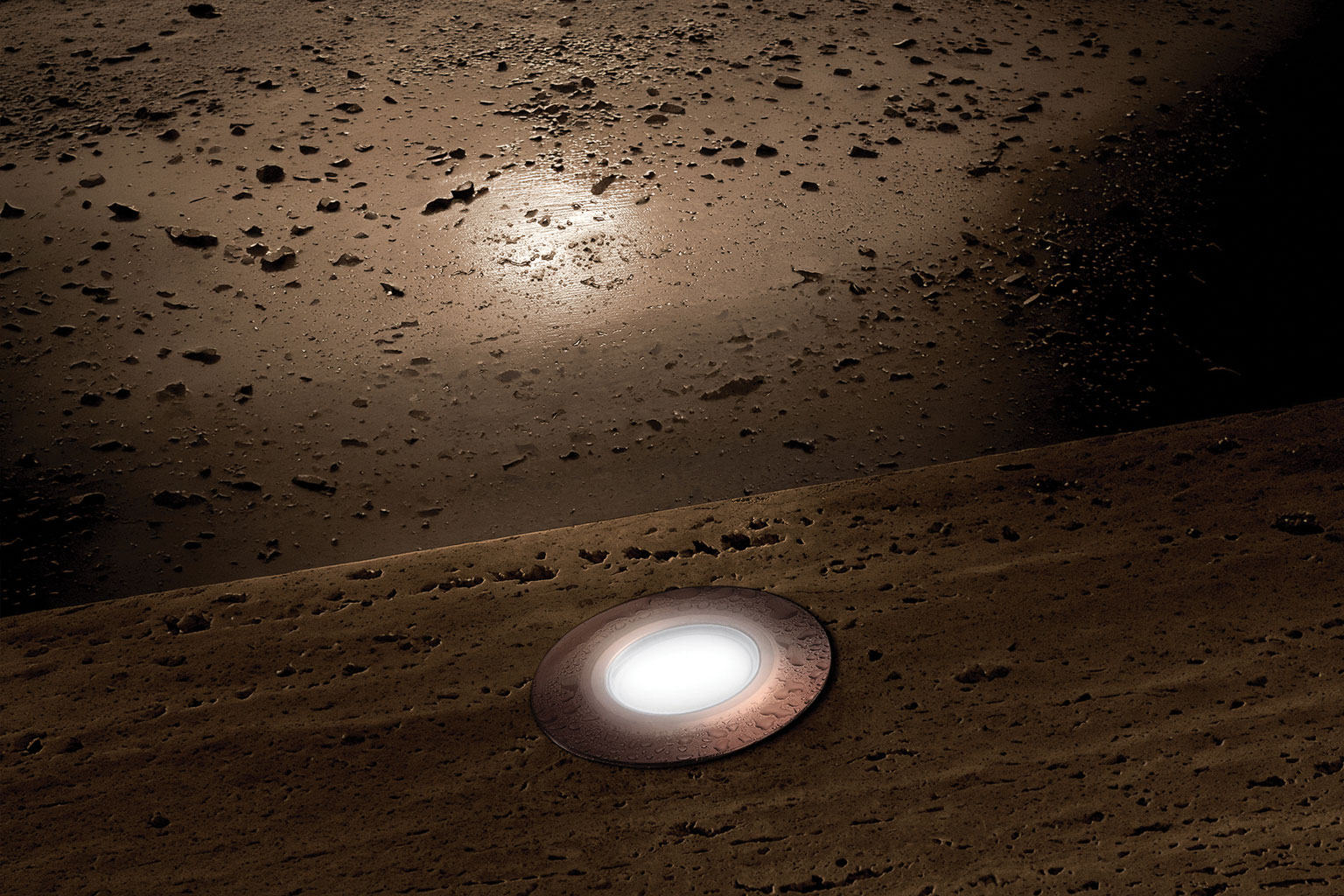
Before any of this, there is the question of protection integrity. The IP rating of a luminaire, from IP44 for sheltered installations to IP65 for exposed facades and IP67 for pool edges, defines the level of protection against water and particulate ingress. But the IP rating is a system property. A single damaged gasket or an incorrectly sealed cable entry is enough to compromise the entire fitting. Specifying the correct rating is necessary. Maintaining it throughout the installation’s service life is equally so.
In architectural outdoor lighting, every choice of material and finish carries consequences that extend across the full life of a project. A luminaire that ages consistently with its environment, whether through patina, permanence, or material strength, is the result of decisions made at the outset with the same rigour as photometric selection and colour temperature specification. Where light meets the elements, the right surface makes all the difference.